
The Jacksonville market in 2026
Jacksonville's market has been one of the steadier Florida markets since the post-pandemic peak. Median home price as of early 2026 sits around $310,000 city-wide, with the metro area averaging closer to $355,000. That's well below the Florida state median of $430,000.
Inventory has loosened. Days on market are up. Sellers are negotiating. It's not a fire sale, but it's clearly not the seller's market it was in 2022.
A few specific dynamics worth knowing:
Insurance is still a problem but less catastrophic here than in South Florida. Many Jacksonville neighborhoods have lower wind risk than the southern half of the state.
Population growth is strong. Jacksonville has added roughly 25,000 residents per year, mostly from out of state.
No state income tax, and Duval County property taxes are middle-of-the-pack for Florida.
Homestead exemption can knock $50,000 off your assessed value if it's your primary residence.
Neighborhoods, ranked by what they actually feel like
Riverside and Avondale
If you want the historic, walkable, character-laden version of Jacksonville, Riverside-Avondale is it. These two neighborhoods (treated as one in most listings) sit just southwest of downtown along the St. Johns River. Tree-lined streets, 1920s Craftsman and Tudor homes, independent restaurants, breweries, and a vibe that's more Asheville than Orlando.
Median home prices: $400,000 to $700,000 for restored historic homes. You can still find fixer-uppers in the $250,000 range, but the better ones tend to need work and they go fast.
What to watch for: many of these homes are 80 to 100 years old. Plumbing, knob-and-tube wiring, foundation issues, and updated-but-not-permitted renovations are common. Get an inspector who knows old houses.
San Marco
Across the river from downtown, San Marco is another historic neighborhood with a more polished, slightly more expensive feel than Riverside. Think Spanish Mediterranean architecture, a charming central square, and quick access to downtown.
Median home price: around $550,000, with plenty of properties in the $400,000 to $800,000 range. Smaller bungalows on the periphery start in the $300,000s.
San Marco has held its value well and tends to attract buyers who want city access without the high-rise condo lifestyle.
Ortega
Ortega is the old-money Jacksonville neighborhood. It sits on a peninsula in the St. Johns River, full of large lots, mature oaks, and historic estates. The Ortega Country Club is the anchor. Crime is low, schools are well-regarded, and the housing stock is some of the best preserved in the city.
Median home price: around $700,000. Waterfront properties hit $2 million and up.
Mandarin
Mandarin is the family suburb on the south side of Jacksonville, along the St. Johns River. Lots of mid-century to 1990s homes, large lots, well-funded schools, and a strong family demographic. It's not flashy, but it's consistently one of the best value-for-money neighborhoods in the city.
Median home price: around $360,000. You can get a 4-bedroom, 2,500-square-foot home with a yard for under $450,000 in most of Mandarin.
If you've got school-age kids and you want a normal suburban setup without HOA headaches, Mandarin is the obvious pick.
Nocatee
Nocatee isn't technically Jacksonville. It's in St. Johns County, about 25 minutes south of downtown. But it's one of the fastest-growing master-planned communities in the entire country, and it competes for the same buyers.
Nocatee is a planned development with multiple villages, two water parks, A-rated St. Johns County schools, hundreds of miles of bike trails, and a town center with restaurants and shops. It's the answer to "I want a brand-new house with everything walking distance and great schools."
Median home price: around $625,000. Custom homes hit $1.5 million. There's also a small number of homes under $500,000, mostly townhomes.
Watch the HOA and CDD fees. Nocatee has both, and they add real money to the monthly cost. Read the disclosures.
The Beaches: Atlantic, Neptune, and Jacksonville Beach
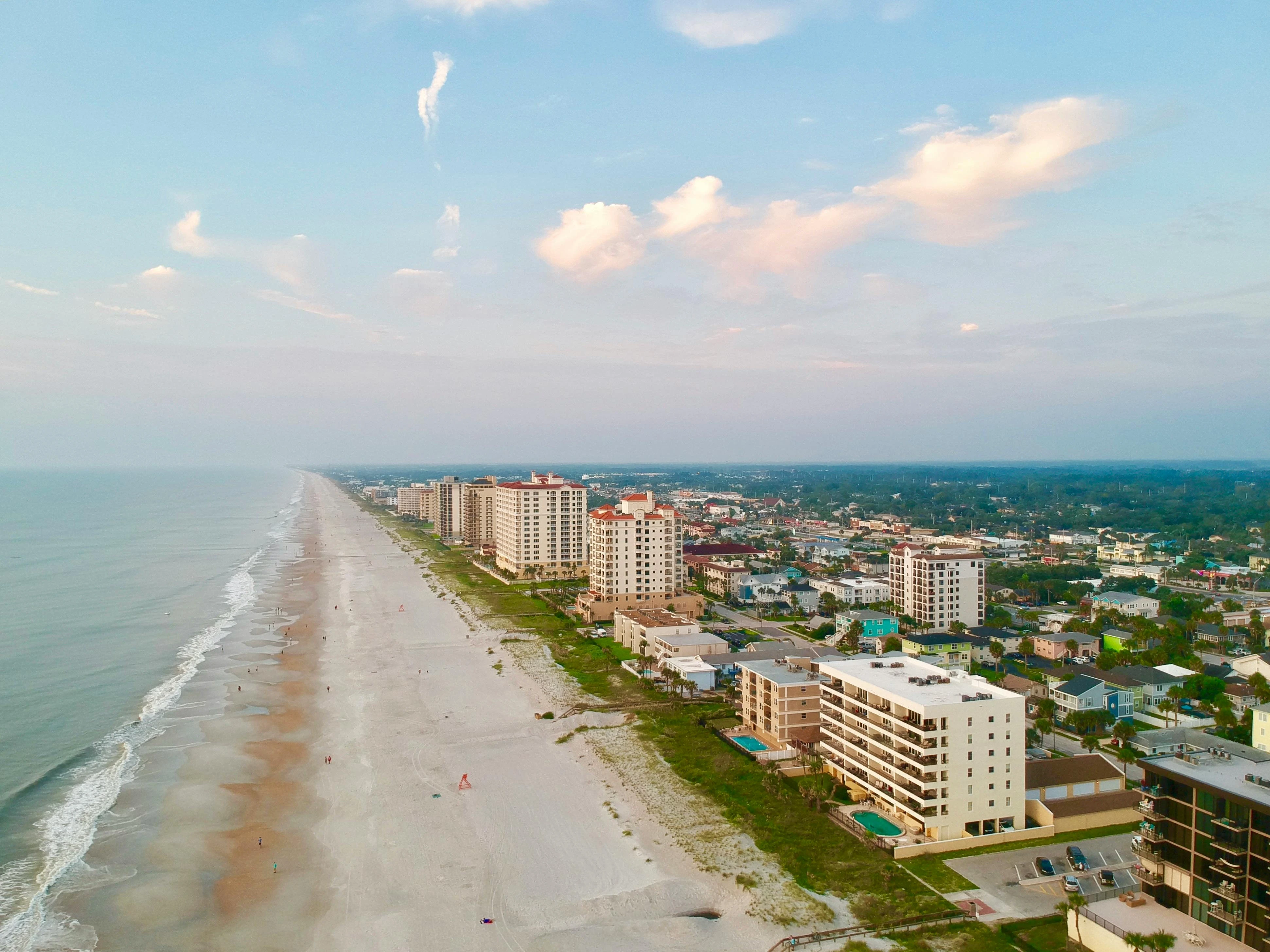
Jacksonville's beach communities are three small cities clustered together at the eastern edge of the metro area. They're about 20 to 30 minutes from downtown depending on traffic.
Atlantic Beach is the most laid-back of the three, with smaller homes, tree-canopied streets, and a more residential feel.
Neptune Beach sits in the middle, with a small town center, an active local scene, and prices similar to Atlantic Beach.
Jacksonville Beach is the largest and most touristy, with high-rise condos, surf shops, and a busy bar scene near the pier.
Median prices vary by block. Walking distance to the water: $750,000 to $1.5 million. A few blocks back: $450,000 to $700,000.
Insurance is the big variable here. Properties east of the Intracoastal Waterway face higher wind premiums and flood insurance requirements. Get quotes before you make an offer.
Northside and downtown core
Jacksonville's Northside and downtown areas are where you find the lowest prices in the metro, with some real fixer-upper deals if you have the appetite. Median prices are well under $250,000 in many ZIP codes.
There's also more variability in crime, school quality, and infrastructure block to block. This is where it really pays to know the specific street, not just the neighborhood name. If you're investor-minded or willing to do significant work, there's value to be found. If you want move-in ready and predictable, look south.
Westside
Jacksonville's Westside is a mix of older suburbs, mid-priced family homes, and pockets of new construction. Median prices: $230,000 to $320,000. Lots of homes from the 1970s and 1980s, large lots, and reasonable commutes to the Naval Air Station and the western edge of downtown.
The Jacksonville market in 2026
Jacksonville's market has been one of the steadier Florida markets since the post-pandemic peak. Median home price as of early 2026 sits around $310,000 city-wide, with the metro area averaging closer to $355,000. That's well below the Florida state median of $430,000.
Inventory has loosened. Days on market are up. Sellers are negotiating. It's not a fire sale, but it's clearly not the seller's market it was in 2022.
A few specific dynamics worth knowing:
Insurance is still a problem but less catastrophic here than in South Florida. Many Jacksonville neighborhoods have lower wind risk than the southern half of the state.
Population growth is strong. Jacksonville has added roughly 25,000 residents per year, mostly from out of state.
No state income tax, and Duval County property taxes are middle-of-the-pack for Florida.
Homestead exemption can knock $50,000 off your assessed value if it's your primary residence.
Neighborhoods, ranked by what they actually feel like
Riverside and Avondale
If you want the historic, walkable, character-laden version of Jacksonville, Riverside-Avondale is it. These two neighborhoods (treated as one in most listings) sit just southwest of downtown along the St. Johns River. Tree-lined streets, 1920s Craftsman and Tudor homes, independent restaurants, breweries, and a vibe that's more Asheville than Orlando.
Median home prices: $400,000 to $700,000 for restored historic homes. You can still find fixer-uppers in the $250,000 range, but the better ones tend to need work and they go fast.
What to watch for: many of these homes are 80 to 100 years old. Plumbing, knob-and-tube wiring, foundation issues, and updated-but-not-permitted renovations are common. Get an inspector who knows old houses.
San Marco
Across the river from downtown, San Marco is another historic neighborhood with a more polished, slightly more expensive feel than Riverside. Think Spanish Mediterranean architecture, a charming central square, and quick access to downtown.
Median home price: around $550,000, with plenty of properties in the $400,000 to $800,000 range. Smaller bungalows on the periphery start in the $300,000s.
San Marco has held its value well and tends to attract buyers who want city access without the high-rise condo lifestyle.
Ortega
Ortega is the old-money Jacksonville neighborhood. It sits on a peninsula in the St. Johns River, full of large lots, mature oaks, and historic estates. The Ortega Country Club is the anchor. Crime is low, schools are well-regarded, and the housing stock is some of the best preserved in the city.
Median home price: around $700,000. Waterfront properties hit $2 million and up.
Mandarin
Mandarin is the family suburb on the south side of Jacksonville, along the St. Johns River. Lots of mid-century to 1990s homes, large lots, well-funded schools, and a strong family demographic. It's not flashy, but it's consistently one of the best value-for-money neighborhoods in the city.
Median home price: around $360,000. You can get a 4-bedroom, 2,500-square-foot home with a yard for under $450,000 in most of Mandarin.
If you've got school-age kids and you want a normal suburban setup without HOA headaches, Mandarin is the obvious pick.
Nocatee
Nocatee isn't technically Jacksonville. It's in St. Johns County, about 25 minutes south of downtown. But it's one of the fastest-growing master-planned communities in the entire country, and it competes for the same buyers.
Nocatee is a planned development with multiple villages, two water parks, A-rated St. Johns County schools, hundreds of miles of bike trails, and a town center with restaurants and shops. It's the answer to "I want a brand-new house with everything walking distance and great schools."
Median home price: around $625,000. Custom homes hit $1.5 million. There's also a small number of homes under $500,000, mostly townhomes.
Watch the HOA and CDD fees. Nocatee has both, and they add real money to the monthly cost. Read the disclosures.
The Beaches: Atlantic, Neptune, and Jacksonville Beach
Jacksonville's beach communities are three small cities clustered together at the eastern edge of the metro area. They're about 20 to 30 minutes from downtown depending on traffic.
Atlantic Beach is the most laid-back of the three, with smaller homes, tree-canopied streets, and a more residential feel.
Neptune Beach sits in the middle, with a small town center, an active local scene, and prices similar to Atlantic Beach.
Jacksonville Beach is the largest and most touristy, with high-rise condos, surf shops, and a busy bar scene near the pier.
Median prices vary by block. Walking distance to the water: $750,000 to $1.5 million. A few blocks back: $450,000 to $700,000.
Insurance is the big variable here. Properties east of the Intracoastal Waterway face higher wind premiums and flood insurance requirements. Get quotes before you make an offer.
Northside and downtown core
Jacksonville's Northside and downtown areas are where you find the lowest prices in the metro, with some real fixer-upper deals if you have the appetite. Median prices are well under $250,000 in many ZIP codes.
There's also more variability in crime, school quality, and infrastructure block to block. This is where it really pays to know the specific street, not just the neighborhood name. If you're investor-minded or willing to do significant work, there's value to be found. If you want move-in ready and predictable, look south.
Westside
Jacksonville's Westside is a mix of older suburbs, mid-priced family homes, and pockets of new construction. Median prices: $230,000 to $320,000. Lots of homes from the 1970s and 1980s, large lots, and reasonable commutes to the Naval Air Station and the western edge of downtown.
Jacksonville is the largest city by area in the lower 48 states. It's also one of the most affordable big cities in Florida, with a median home price about 25 percent below the state average and a long way below what you'd pay for the same square footage in Miami or even Tampa.
But "Jacksonville" covers a lot of ground. We're talking about 875 square miles, half a dozen distinct submarkets, beach towns to the east, suburban St. Johns County to the south, and historic neighborhoods near downtown that look nothing like the master-planned developments in Nocatee.
If you're house-hunting in Jacksonville in 2026, here's what to know about the neighborhoods, the market, and how to actually buy without getting buried in surprises.
Jacksonville is the largest city by area in the lower 48 states. It's also one of the most affordable big cities in Florida, with a median home price about 25 percent below the state average and a long way below what you'd pay for the same square footage in Miami or even Tampa.
But "Jacksonville" covers a lot of ground. We're talking about 875 square miles, half a dozen distinct submarkets, beach towns to the east, suburban St. Johns County to the south, and historic neighborhoods near downtown that look nothing like the master-planned developments in Nocatee.
If you're house-hunting in Jacksonville in 2026, here's what to know about the neighborhoods, the market, and how to actually buy without getting buried in surprises.
Schools: a quick map
Duval County Public Schools is Jacksonville's main district, and like any big district, quality varies a lot. The standout pattern is that St. Johns County, just south of Jacksonville, runs one of the best public school systems in the entire state. This is why so many Jacksonville-adjacent buyers cross the county line and end up in places like Nocatee, Julington Creek, or Fruit Cove.
Inside Duval County, well-regarded zones include parts of Mandarin, San Marco, Avondale, and the Beaches. Magnet and IB programs are strong options if you're flexible on geography.
Property taxes and insurance
Duval County's effective property tax rate is around 0.94 percent. On a $400,000 home, that's roughly $3,760 per year, before any exemptions.
The Florida homestead exemption shaves up to $50,000 off the assessed value for primary residences. Apply for it. Tens of thousands of Florida homeowners forget to claim it and pay extra every year.
Insurance is where Jacksonville buyers get surprised. Even though Jacksonville is generally lower-risk than South Florida, premiums have climbed significantly. Budget $2,500 to $4,500 per year for a typical inland home, and $5,000 to $9,000 for a beachfront or near-beach property.
Find your home.
Get up to 2% back.
Search homes, schedule tours, make smarter offers, and get thousands back at closing with Homa
Find your home.
Get up to 2% back.
Search homes, schedule tours, make smarter offers, and get thousands back at closing with Homa
Find your home.
Get up to 2% back.
Search homes, schedule tours, make smarter offers, and get thousands back at closing with Homa
Buying process: what to expect
Here's the rough timeline for a typical Jacksonville purchase, assuming a financed deal with normal contingencies:
Get pre-approved: 3 to 14 days
Tour homes: 2 weeks to 4 months
Make offer and go under contract: a few days
Inspection: within 10 days of contract
Appraisal: within 2 to 3 weeks
Underwriting and insurance binding: parallel with appraisal
Closing: 30 to 45 days after going under contract
Cash deals can close in 7 to 14 days. New construction in places like Nocatee runs on the builder's timeline, which can be months.
Jacksonville-specific gotchas
Roof age and four-point inspections
Florida insurers won't write a policy on most homes with a roof older than 15 years (some insurers cut off at 20 or 25, but 15 is becoming the standard). A four-point inspection (roof, electrical, plumbing, HVAC) is required for most policies. If any of those four come back "end of useful life," you'll have a hard time getting insured. Find this out before you go under contract, not the week before closing.
Flood zones
Jacksonville has a lot of waterfront and low-lying property. Check the FEMA flood map for any house you're considering. If it's in an AE or VE zone, flood insurance is required and runs separately from your homeowners policy.
Septic vs sewer
Plenty of Jacksonville homes, especially in less dense areas and St. Johns County, are on septic systems instead of city sewer. Septic isn't bad, but it requires maintenance and the cost of a system failure is real. Have it inspected separately during your due diligence period.
CDD fees in newer developments
Many of Jacksonville's newer master-planned communities have CDD (Community Development District) fees on top of HOA fees. These are essentially bond payments that pay back the infrastructure cost of the development. They can run $1,500 to $3,000 per year per house. Check the property listing for both HOA and CDD numbers.
Buying process: what to expect
Here's the rough timeline for a typical Jacksonville purchase, assuming a financed deal with normal contingencies:
Get pre-approved: 3 to 14 days
Tour homes: 2 weeks to 4 months
Make offer and go under contract: a few days
Inspection: within 10 days of contract
Appraisal: within 2 to 3 weeks
Underwriting and insurance binding: parallel with appraisal
Closing: 30 to 45 days after going under contract
Cash deals can close in 7 to 14 days. New construction in places like Nocatee runs on the builder's timeline, which can be months.
Jacksonville-specific gotchas
Roof age and four-point inspections
Florida insurers won't write a policy on most homes with a roof older than 15 years (some insurers cut off at 20 or 25, but 15 is becoming the standard). A four-point inspection (roof, electrical, plumbing, HVAC) is required for most policies. If any of those four come back "end of useful life," you'll have a hard time getting insured. Find this out before you go under contract, not the week before closing.
Flood zones
Jacksonville has a lot of waterfront and low-lying property. Check the FEMA flood map for any house you're considering. If it's in an AE or VE zone, flood insurance is required and runs separately from your homeowners policy.
Septic vs sewer
Plenty of Jacksonville homes, especially in less dense areas and St. Johns County, are on septic systems instead of city sewer. Septic isn't bad, but it requires maintenance and the cost of a system failure is real. Have it inspected separately during your due diligence period.
CDD fees in newer developments
Many of Jacksonville's newer master-planned communities have CDD (Community Development District) fees on top of HOA fees. These are essentially bond payments that pay back the infrastructure cost of the development. They can run $1,500 to $3,000 per year per house. Check the property listing for both HOA and CDD numbers.
The Homa angle for Jacksonville buyers
Jacksonville is one of the Florida markets where Homa is most active. The combination of a softer-than-average market, plenty of inventory, and a lot of out-of-state buyers moving in makes it a place where AI-powered analysis and rebated commissions can save real money.
Homa's tools pull comp analysis, flood and wind zones, roof age, climate risk projections, and HOA/CDD disclosures into one view, so you're not piecing together the picture from a dozen tabs. Showings are on demand through local Jacksonville-based showing specialists, not on a single agent's calendar. And part of the seller-paid commission gets rebated back to you at closing, which can go toward your closing costs, your mortgage rate buydown, or just stay in your account.
If you're shopping Jacksonville for the value, the rebate matters. It's real money working in your favor on top of whatever you negotiate on the price.
The Homa angle for Jacksonville buyers
Jacksonville is one of the Florida markets where Homa is most active. The combination of a softer-than-average market, plenty of inventory, and a lot of out-of-state buyers moving in makes it a place where AI-powered analysis and rebated commissions can save real money.
Homa's tools pull comp analysis, flood and wind zones, roof age, climate risk projections, and HOA/CDD disclosures into one view, so you're not piecing together the picture from a dozen tabs. Showings are on demand through local Jacksonville-based showing specialists, not on a single agent's calendar. And part of the seller-paid commission gets rebated back to you at closing, which can go toward your closing costs, your mortgage rate buydown, or just stay in your account.
If you're shopping Jacksonville for the value, the rebate matters. It's real money working in your favor on top of whatever you negotiate on the price.


